Turn operational chaos into clear, reliable processes.
For SME owners and operations leaders who are done with firefighting, key-person dependency, and tool chaos – and want a practical way to fix their core workflows.
≈ 7–10 minutes
No slides, no theory – just a clear picture of how work really flows today.
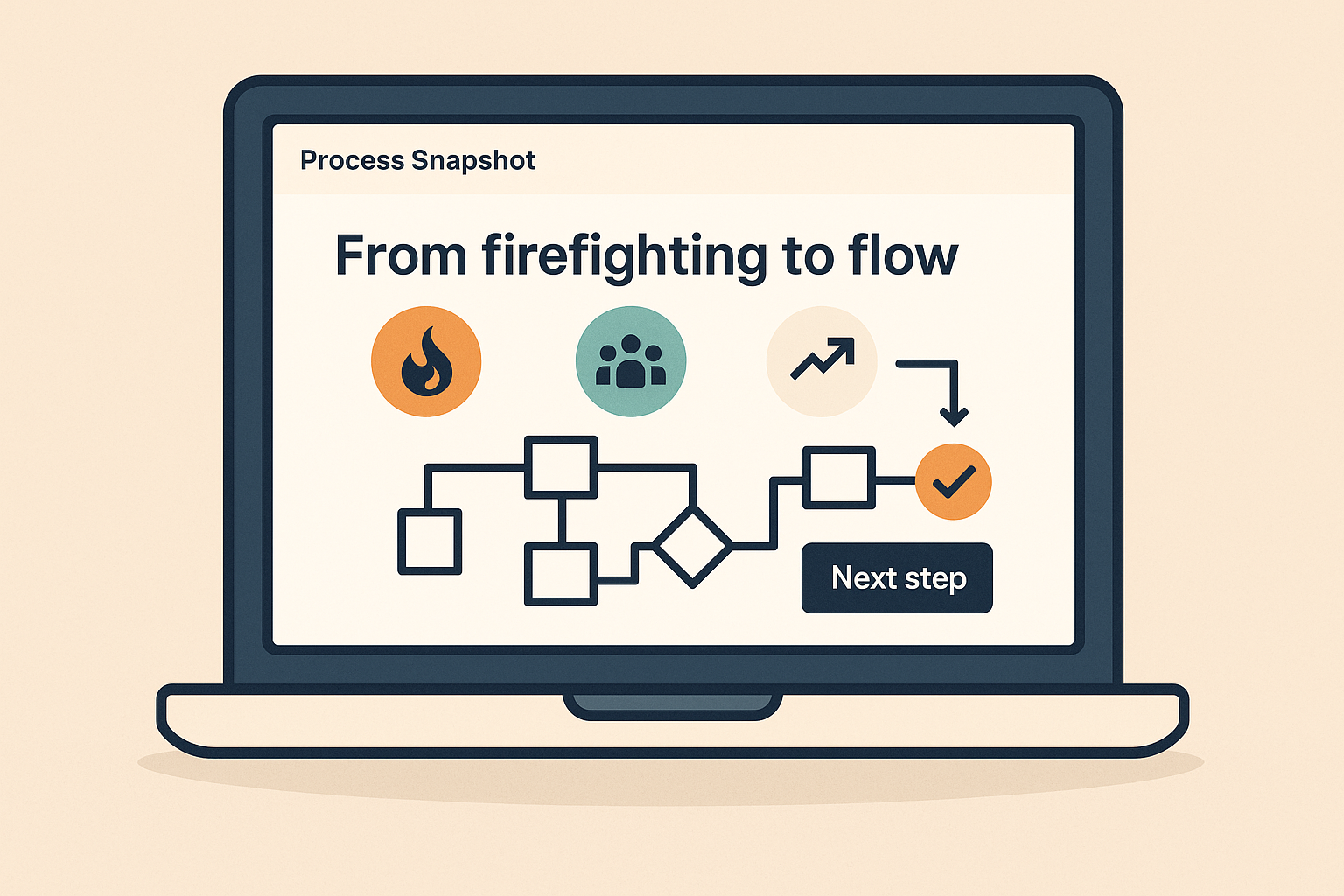
Process Snapshot
From firefighting to flow
A quick, structured view of stability, capacity, and key-person risk across your core workflows.
- See where chaos, overload, or tool-misfit really live.
- Spot the workflow that will free the most capacity.
- Get a focused next-step recommendation.
Does This Sound Like Your Business?
Many SMEs reach a point where success on the outside hides growing friction on the inside.

Constant Firefighting
Every week is a new emergency. Plans rarely survive Monday morning and you’re always pulled into operational issues.

Key-Person Dependency
If a few key people are out, everything slows or stops. A lot of critical know-how lives in people’s heads, not in your systems.

Tool Chaos
You’ve bought systems like ERP or CRM, but work still feels messy and manual. Tools don’t really match how work actually happens.
If any of this feels uncomfortably familiar, you’re in the right place.
How it works
How the Process Advantage Journey Works
Step 1
Diagnose
Start with the Process Health Scan to see where your main constraint lies: chaos, dependency, or digital tool misfit.
- Short online scan
- Clear stability & capacity view
- Initial recommendations
Step 2
Focus
Pick one core workflow and apply the method through a short, online program so you see real change in a contained area.
- Choose a real workflow
- Apply simple tools and templates
- Measure stability and throughput
Step 3
Develop
Build internal capability step by step so your team can keep improving processes without relying on external experts.
- Embed new ways of working
- Give owners clear responsibilities
- Create a repeatable improvement cycle
A Practical BPM Method for Companies Without a Process Department
The Process Advantage Method combines the discipline of business process management with the reality of running an SME. It focuses on a few critical workflows at a time, using simple tools that managers and teams can work with.
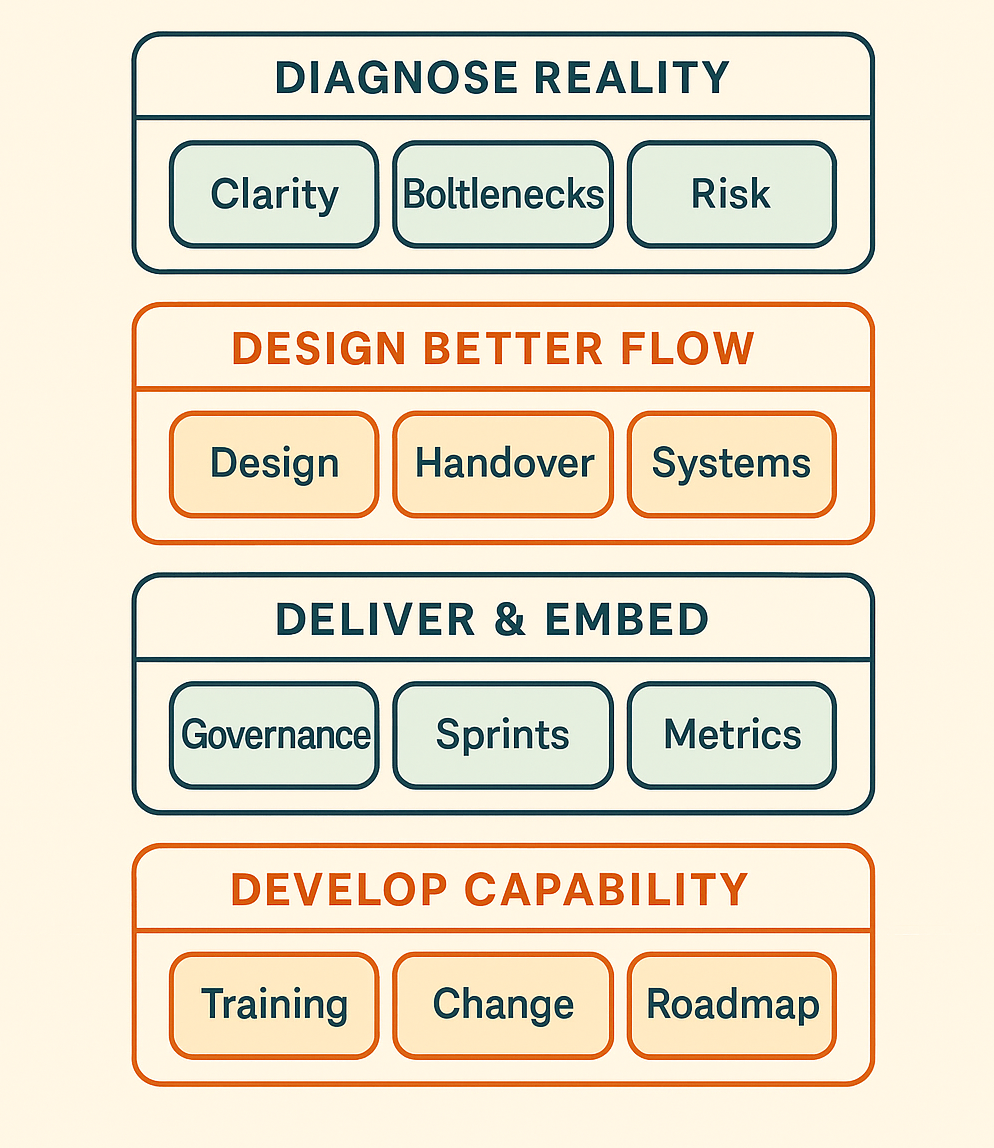
It’s built around four phases – Diagnose, Design, Deliver, Develop – and twelve building blocks that cover clarity, handovers, capacity, governance, and capability.
Method at a glance
Start with a Focused Program
Apply the method to one real workflow in your business and see measurable impact in weeks.
Theme A · Operational Chaos
A1 – Firefighting to Flow
Stabilise one mission-critical workflow in 4 weeks. Reduce firefighting, make work more predictable, and create a simple “control panel” for operations.
Theme A · Operational Chaos
A2 – Capacity Sprint
Increase throughput and free up capacity in a key workflow without hiring. A focused 4–5 week sprint with baseline, redesign, and measurable results.
More programs for key-person dependency and digitalization coming soon.
Who This Is For
The Process Advantage Method and programs are tailored for organisations that:
- Have roughly 50–200 employees.
- Are growing or changing, but feel operations are “barely holding together”.
- Depend heavily on a few key people who know how to “make it work”.
- Are investing in tools (ERP, CRM, ticketing, etc.) but don’t see the promised gains.
If your business is successful on the outside but messy on the inside, you are exactly who this was designed for.
Why Listen to Me?
I have been working in the realms of small business development and marketing for over 20 years. Finding ways to streamline business processes and systems has been a passion that I put to the test in my own businesses and for many others over my career.
My work focuses on helping SMEs turn process thinking into something practical: stabilising workflows, freeing capacity, and making operations less dependent on individual heroes.

Ready to See Where Your Real Constraints Are?
Start with the free Process Health Scan. It’s the simplest way to turn intuition into a clear picture – and decide where to focus first.
It takes about 7 minutes. You’ll receive your summary by email so you can review and share it with your team.